
Snowwhite2: Printing a PVA (Polyvinyl Alcohol) Powder
Discover optimal parameters for 3D printing PVA powder on the Sharebot SnowWhite2 SLS system. Expert R&D insights on drying, thermal profiles, and process setup.
Snowwhite2: Affordable SLS
SnowWhite2 is a uniquely accessible, high-end SLS printer specifically engineered for research and development. Unlike many competitors, we design and build every component entirely in-house, ensuring unmatched longevity and hardware synergy. This vertical integration allows us to provide instant, global remote support, intervening anywhere in the world to guarantee your research never stops. By balancing affordability with professional performance, Sharebot remains the definitive partner for universities and R&D departments seeking total control and reliability.
SnowWhite2: Development of an Ergonomic Additively Manufactured Modular Saddle for Rehabilitation Cycling
One of SnowWhite2’s most innovative features is the ability to change the powder distribution system, a crucial factor for optimizing printing processes and expanding research possibilities. Depending on research and development needs, users can choose from several interchangeable distributors
SnowWhite2: Pharmaceutical Powder Recyclability
One of SnowWhite2’s most innovative features is the ability to change the powder distribution system, a crucial factor for optimizing printing processes and expanding research possibilities. Depending on research and development needs, users can choose from several interchangeable distributors
SnowWhite2: Powders with a low melting point
One of SnowWhite2’s most innovative features is the ability to change the powder distribution system, a crucial factor for optimizing printing processes and expanding research possibilities. Depending on research and development needs, users can choose from several interchangeable distributors
Snowwhite2 paper: Innovating Steel – Filters & Refractories
Welcome back to our exploration of cutting-edge research made possible, in part, by the precision of the Sharebot Snowwhite SLS 3D printing technology. Today, we’re featuring the scientific paper “Functionalized Feeders, Hollowware, Spider Bricks and Starter Casting Tubes for Increasing the Purity in Steel Casting Processes“. To begin, we’ll provide a straightforward explanation of what the study investigated and the main results it uncovered. Following this accessible overview, we’ll share the original abstract and relevant citations for a more in-depth look.
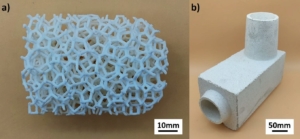
a) Template printed using Snowwhite – b) Runner end piece for industrial casting
Understanding the study and its main result
This paper is about improving the purity of steel during a specific casting process called “ingot casting by bottom teeming.” This method is often used for high-quality, specialized steels.
The researchers found a promising way to make the steel cleaner: by using filters. They made special foam-like filters using a 3D printing technique called selective laser sintering (SLS), and they specifically used our Snowwhite printer for this. These printed foam structures were then turned into strong filters using other techniques.
They also looked at improving the containers and tubes (called “hollowware refractories”) that hold and guide the molten steel. They made these components “reactive” by adding special coatings, which helps remove existing impurities and stops new ones from forming.
The big idea is to use both the Sharebot Snowwhite-produced “active” filters and the “reactive” hollowware components together. This combination creates a powerful filtration system that uses the best parts of both methods to clean the steel.
They tested these new ideas in real industrial settings with a company called Deutsche Edelstahlwerke Specialty Steels Europe GmbH (DEW). After the tests, they examined the materials and steel samples to see how well the new methods worked compared to the old ones.
Main result
The key discovery here is the development of a combined filtration system that significantly improves the purity of specialty and alloy steels during ingot casting. By simultaneously using 3D-printed “active” filters and specially coated “reactive” refractory components, they found a more effective way to remove impurities from molten steel. This leads to higher quality steel products.
Functionalized Feeders, Hollowware, Spider Bricks and Starter Casting Tubes for Increasing the Purity in Steel Casting Processes
Tony Wetzig, Matthias Schwarz, Leandro Schöttler, Patrick Gehre & Christos G. Aneziris
Ref.: https://link.springer.com/chapter/10.1007/978-3-031-40930-1_32
Abstract
Although continuous casting became the state of the art for the casting of ordinary steel grades, ingot casting by bottom teeming still has relevance in the steelmaking industry, especially for the manufacturing of specialty and alloy steels. As for every casting process, the ever-increasing quality requirements by customers lead to increased demand for new technologies to increase the purity of the cast steel melt regarding its inclusion content. Due to the special design of the bottom-teeming ingot casting facility and the discontinuous operation as batch process, the application of filters is a promising approach. Tailored foam geometries were prepared based on additive manufacturing via selective laser sintering (SLS) and transformed into filters via modified replication techniques and flame spraying. Additionally to filter application, the functionalization and quality improvement of applied hollowware refractories has high potential to remove existing inclusions from the steel melt and avoid the formation of new inclusions during casting. The investigated hollowware components were manufactured by pressure slip casting on the basis of coarse-grained alumina compositions and subsequent functionalization by spray coating based on carbon-bonded alumina slurries. Simultaneous application of functionalized, “reactive” refractory components and flame-sprayed, “active” filters enables a combined filtration system which unites the advantages of the distinct filtration mechanisms. In the continuous casting of specialty steels, the conditions are more severe resulting in additional challenges regarding the application of filters. An approach investigated in this subproject is the use of extruded filter starter casting tubes above the tundish outlet. To achieve this, extrusion mixes based on cellulose derivatives and materials of the system Al2O3-ZrO2-C (AZC) were investigated for their suitability. The new concepts were tested in industrial casting trials in cooperation with the company Deutsche Edelstahlwerke Specialty Steels Europe GmbH (DEW). Post-mortem, the former melt-refractory interface of the applied components was investigated and steel samples from the ladle, the gating system and the ingot were analyzed in comparison to untreated samples.
Snowwhite2 paper: Monotonic and cyclic compressive performance of self-monitoring materials
Our exploration of scientific advancements made possible by the Sharebot Snowwhite2 SLS 3D printer takes us to a fascinating study: “Monotonic and cyclic compressive performance of self-monitoring MWCNT/PA12 cellular composites manufactured by selective laser sintering“. In this piece, we’ll break down the core problem this research aimed to solve and the key discoveries they made. For those who want to dive deeper, we’ll also provide the original abstract and all referenced sources.
Understanding the study and its main result
This study looked at the mechanical and electrical properties of special 3D-printed structures when squished. These structures were shaped like honeycombs and made using our Sharebot Snowwhite2 3D printer. They used two different materials: pure PA12 (a type of plastic) and a mix of PA12 with carbon nanotubes (MWCNTs).
Here’s what they found:
- Pure PA12 structures were stronger and could absorb more energy, especially the denser ones (30% and 40% solid material).
- The MWCNT/PA12 structures were not as strong or stiff as the pure PA12 ones, but they were very good at absorbing energy (up to 53% efficiency).
- Most interestingly, the MWCNT/PA12 structures could sense strain, meaning their electrical resistance changed when they were deformed. They were very good at this, acting like built-in sensors.
- When these MWCNT/PA12 structures were repeatedly squished, their electrical resistance significantly increased as they got damaged. This means they could potentially detect damage as it happens.
Main result
The main discovery is that 3D-printed honeycomb structures made from a blend of PA12 and carbon nanotubes (MWCNTs) can act as self-sensing materials. They are not only good at absorbing energy but also have the remarkable ability to detect strain and damage as it occurs. This opens up possibilities for creating smart, lightweight structures that can sense their own condition, which could be useful in many applications like aerospace or automotive industries for real-time monitoring.
Monotonic and cyclic compressive performance of self-monitoring MWCNT/PA12 cellular composites manufactured by selective laser sintering
Muhammad Umar Azam (a), S Kumar (b), Andreas Schiffer (a) (c)
a) Department of Mechanical and Nuclear Engineering, Khalifa University of Science and Technology, Abu Dhabi, 127788, United Arab Emirates
b) James Watt School of Engineering, University of Glasgow, Glasgow, G12 8QQ, UK
c) Advanced Research and Innovation Center (ARIC), Khalifa University of Science and Technology, 127788, Abu Dhabi, United Arab Emirates
Ref.: https://www.sciencedirect.com/science/article/pii/S2666682025000106
Abstract
Herein, we experimentally investigate the mechanical and piezoresistive properties of selectively laser-sintered cellular composites under monotonic and cyclic compressive loading. Hexagonal honeycomb structures (HHSs) with relative densities of 20 %, 30 %, and 40 % were 3D printed from a ball-milled nanocomposite powder of multi-walled carbon nanotubes (MWCNTs) and polyamide 12 (PA12) with 0.3 wt.% MWCNTs. The pure PA12 HHSs exhibited lower porosity and superior mechanical properties, including collapse strength, elastic modulus and energy absorption, particularly at higher relative densities (30 % and 40 %). Notably, the specific energy absorption for the PA12 HHSs reached 24 J g⁻¹, under out-of-plane compression at 40 % relative density. Compared to neat PA12, the MWCNT/PA12 HHSs showed a reduction in strength and modulus but demonstrated excellent energy absorption efficiency of up to 53 %. Moreover, MWCNT/PA12 HHSs exhibited exceptional strain-sensing capabilities in the elastic region with gauge factors of up to 25. Cyclic tests showed that the zero-load resistance increased significantly as damage progressed during the collapse phase, highlighting their potential for application in smart, lightweight structures with integrated strain and damage-sensing functionalities.