• Link to Facebook
  • Link to X
  • Link to Youtube
  • Link to Instagram
  • Italiano Italiano Italian it
  • English English English en
Sharebot
  • Home
  • About us
    • Contact us
    • Our History
  • Printers
    • SnowWhite 2 SLS
    • SnowWhite 2 HT SLS
    • metalONE DMLS
    • Defiant 600x600x600
    • Odyssey 1,000×1,200×1,000
    • Enterprise 1,200×2,000×1,200
    • Galaxy DLP
    • Wax Jet MPJ
  • Post
  • Support center
    • Contact and info
    • Download
  • Resources
    • Case Histories
    • Brochures
    • Logos
    • Terms and conditions
  • Click to open the search input field Click to open the search input field Search
  • Menu Menu

Snowwhite2 paper: Selective laser sintering for printing bilayer tablets

21 May 2025

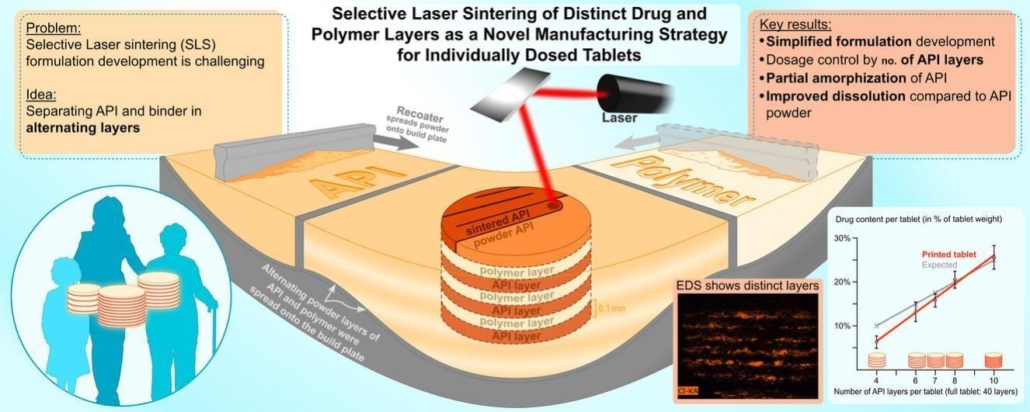
Our journey through scientific discoveries enabled by the Snowwhite SLS 3D printer continues with an examination of the paper titled “Selective laser sintering for printing bilayer tablets“. We’ll start by making the research accessible, explaining the central question the study addressed and the primary findings. Afterwards, we’ll include the original abstract and any cited sources for those wishing to explore the finer points of the work.

Understanding the study and its main result

This research used a our Snowwhite2 to make special two-layer tablets. These tablets contained two different medicines: rosuvastatin and acetylsalicylic acid.

First, the researchers made single-layer tablets of each medicine separately. They used different laser strengths to see how that affected the tablets’ properties like how well they dissolved, how easily they broke (friability), and how hard they were.

After figuring out the best settings, they created the two-layer tablets. They used a new technique that involved a 3D-printed case to hold the different medicine powders in the right places during printing.

The results showed that stronger lasers made the tablets denser, harder, less likely to break, and released the medicine more slowly. Also, the new method successfully created perfectly aligned two-layer tablets, and combining the two medicines didn’t significantly change how they dissolved.

Main result

The main discovery here is that it’s possible to use Selective Laser Sintering (SLS) 3D printing to create multi-material drug delivery systems. In simpler terms, they figured out a way to 3D print pills with different medications in separate layers, and they developed a new method to make sure those layers are perfectly aligned. This opens the door for making more complex and customized medicine combinations in a single tablet.

Selective laser sintering for printing bilayer tablets

Laura Andrade Junqueira (a), Atabak Ghanizadeh Tabriz (a), Vivek Garg (b), Siva Satyanarayana Kolipaka (c), Ho-Wah Hui d, Nathan Boersen (d), Sandra Roberts (d), John Jones (e), Dennis Douroumis (a) (c)
a) Delta Pharmaceutics Ltd., Chatham, Kent ME4 4TB, UK
b) Wolfson Centre for Bulk Solids Handling Technology, Faculty of Engineering & Science, University of Greenwich, Central Avenue, Chatham ME4 4TB, UK
c) Centre for Research Innovation (CRI), University of Greenwich, Chatham ME4 4TB, UK
d) Drug Product Development, Bristol Myers Squibb, 556 Morris Avenue, Summit, NJ 07901, USA
e) Bristol Myers Squibb, Reeds Lane, Moreton, Wirral, UK

Ref.: https://doi.org/10.1016/j.ijpharm.2024.125116

Abstract

In this study Selective Laser Sintering (SLS) was used to produce bilayer tablets containing rosuvastatin and acetylsalicylic acid. Initially, monolithic tablets of each drug were manufactured using different laser intensities in order to identify their impact on the tablet’s dissolution, friability and hardness. After the optimization, the final bilayer tablet was fabricated using a new method, that allowed the printing using different powder blends. For that, a 3D-printed casing was employed to maintain the compartments of the tablet in the correct position during the printing process. The results demonstrated that the increased laser intensities led to denser inner cores, enhanced hardness, decreased friability, and slower drug release. Moreover, the new method was able to produce bilayer tablets completely aligned, showing a minor impact on dissolution when the two compartments were printed together in a single tablet. The work demonstrated the feasibility of using SLS in the production of multi-material drug delivery systems.

/wp-content/uploads/2022/06/logoSharebot.jpg 0 0 site-admin /wp-content/uploads/2022/06/logoSharebot.jpg site-admin2025-05-21 16:28:352025-05-21 16:28:35Snowwhite2 paper: Selective laser sintering for printing bilayer tablets

Snowwhite2 paper: Understanding the mechanisms of gold(III) adsorption

18 May 2025

In this installment of our series showcasing the impact of the Snowwhite SLS 3D printer on scientific advancement, we’re focusing on the paper “Understanding the mechanisms of gold(III) adsorption onto additively manufactured polyamide adsorbent, AM-N12“. We’ll kick things off by breaking down the study’s purpose and its key outcomes in plain language, ensuring everyone can grasp the significance of the research. Then, for those interested in the technical details, we’ll present the original abstract and any associated references.

Understanding the study and its main result

This scientific paper looks at how well a special type of plastic material, made using our Snowwhite2, can grab gold (specifically, gold with a +3 charge, written as gold(III)) from solutions that contain many different metals. The researchers found that the plastic works best at a very acidic condition (pH 0) for capturing the most gold. Even when other metals like platinum, palladium, copper, and others were present in the solution, the plastic was very good at picking out only the gold.

The way the gold sticks to the plastic seems to be mainly in a single layer. The speed at which the gold attaches to the plastic follows common patterns. Computer modeling suggests that the gold(III) might stick to the plastic through different forces, including negative charges repelling each other (anion-anion interaction), positive and negative charges attracting (electrostatic attraction), and a weaker type of bond called hydrogen bonding.

When they looked closely at the plastic after it had captured gold, they found that some of the gold(III) had changed into gold with a +1 charge (gold(I)), and even some pure gold metal (gold(0)). This means a chemical reaction happened where the gold was reduced. Lastly, they were able to remove about half of the captured gold from the plastic using a mixture of chemicals, and they could reuse the plastic again.

Main result

The main discovery is that this specifically designed 3D-printed plastic material (AM-N12) is highly selective for capturing gold(III) from complex mixtures of metals. Importantly, the researchers also found that during the capture process, some of the gold(III) is converted into lower forms of gold (gold(I) and gold(0)) on the surface of the plastic. This suggests that the plastic not only adsorbs the gold but also plays a role in a chemical reduction reaction. They also showed that the gold can be partially removed and the plastic can be reused.

Understanding the mechanisms of gold(III) adsorption onto additively manufactured polyamide adsorbent, AM-N12

Asiia Hurskainen (a), John Kwame Bediako (a), Youssef El Ouardi (a), Morad Lamsayah (b), Janne Frimodig (c), Eveliina Repo (a)
a) Department of Separation Science, School of Engineering Science, Lappeenranta-Lahti University of Technology (LUT), FI-53850 Lappeenranta, Finland
b) Laboratory of Applied and Environmental Chemistry (LCAE), Faculty of Science, University Mohammed First, 60 000 Oujda, Morocco
c) Department of Chemistry, University of Jyväskylä, P.O. Box 35, FI-40014 Jyväskylä, Finland

Ref.: https://www.sciencedirect.com/science/article/pii/S0009250924014301

Abstract

The focus of this paper is to study the adsorption behavior and mechanisms of gold(III) onto additively manufactured polyamide adsorbent, AM-N12 from synthetic multimetal leached solutions. Study of the effect of pH revealed that pH 0 was the optimum condition for reaching maximum gold(III) adsorption. In competitive mixtures containing Au(III) and other metal ions, i.e., Pt, Pd, Cu, Al, Fe, Pb, Sn, Ni, and Zn, extremely high selectivity towards Au ions was observed. Fitting of the adsorption isotherm data showed the order of Freundlich < Langmuir < Sips model, depicting likely monolayer adsorption process. Moreover, the kinetics data fitted well to the pseudo-first-order and pseudo-second-order models. Density Functional Theory (DFT) molecular modelling suggested anion–anion interaction, electrostatic attraction, and hydrogen bonding as possible adsorption mechanisms of gold(III). Furthermore, characterization and X-ray photoelectron spectroscopy (XPS) analysis indicated that after adsorption, portions of Au(III) were reduced to Au(I) and some portions were further reduced to Au(0), thus signifying reduction reaction. Finally, approximately 50 % of the adsorbed gold(III) was desorbed in 24h which was appro and the adsorbent regenerated using a mixture of 0.5 M thiourea and 1 M Hcl.

/wp-content/uploads/2022/06/logoSharebot.jpg 0 0 site-admin /wp-content/uploads/2022/06/logoSharebot.jpg site-admin2025-05-18 17:53:022025-05-18 17:53:02Snowwhite2 paper: Understanding the mechanisms of gold(III) adsorption

Snowwhite2 paper: Recovery of rare elements from mining wastewater

18 May 2025

Welcome back to our series highlighting the exciting ways the Snowwhite SLS 3D printing technology is contributing to scientific discovery. Today, we’re diving into the research presented in the paper “Recovery of rare earth elements from mining wastewater with aminomethylphosphonic acid functionalized 3D-printed filters“. We’ll start by explaining the core of this study and its main findings in simple terms, making it easy to understand. After that, we’ll take a look at the original abstract and any relevant references for those who want to delve deeper into the specifics of the research.

Understanding the study and its main result

This scientific paper talks about a new way to get valuable metals called Yttrium (Y), Neodymium (Nd), and Dysprosium (Dy) from waste left over from mining. This waste also has other metals like Aluminum (Al), Potassium (K), Calcium (Ca), Scandium (Sc), Iron (Fe), Cobalt (Co), Copper (Cu), Zinc (Zn), and Uranium (U).

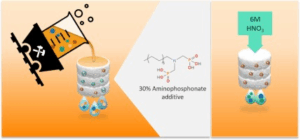
The scientists made special filters using a our Snowwhite2 and Nylon-12. They added another chemical, α-aminomethylphosphonic acid, to these filters to help grab the metals. They chose Nylon-12 because it doesn’t react with the metals they were studying. They used powerful microscopes and X-rays to see the tiny structure of the filters, like how many holes they had and how the special chemical was spread inside. They also used another technique called FTIR to see how the filters changed after they were made and after they soaked up the metals. The scientists tested how well the filters could grab the metals at different levels of acidity (pH). They found that Scandium (Sc) was grabbed the most, followed by Iron (Fe) and Uranium (U), and then Y, Nd, and Dy. Aluminum, Copper, Zinc, Potassium, Calcium, and Cobalt were grabbed the least. They then tried to take the valuable metals back out of the filters using a strong acid. They found that they could get most of the Y, Nd, and Dy back out, but Scandium, Iron, and Uranium stayed stuck in the filters.

Main result

The main discovery is that these specially designed 3D-printed filters can effectively separate and recover the valuable rare earth elements Yttrium (Y), Neodymium (Nd), and Dysprosium (Dy) from complex mining waste, while leaving behind unwanted metals like Scandium, Iron, and Uranium. This method could be useful for cleaning up mining waste and getting valuable resources at the same time.

Recovery of rare earth elements from mining wastewater with aminomethylphosphonic acid functionalized 3D-printed filters

Emilia J. Virtanen (a) (c), Esa Kukkonen (a) (c), Janne Yliharju (b) (c) (d) , Minnea Tuomisto (e), Janne Frimodig (a), Kimmo Kinnunen (b) (c), Elmeri Lahtinen (a), Mikko M. Hänninen (a), Ari Väisänen (a), Matti Haukka (a), Jani O. Moilanen (a) (c)

a) Department of Chemistry, University of Jyväskylä, P.O. Box 35, FI-40014 Jyväskylä, Finland
b) Department of Physics, University of Jyväskylä, P.O. Box 35, FI-40014 Jyväskylä, Finland
c) Nanoscience Center, University of Jyväskylä, P.O. Box 35, FI-40014 Jyväskylä, Finland
d) School of Resource Wisdom, University of Jyväskylä, P.O. Box 35, FI-40014 Jyväskylä, Finland
e) Department of Chemistry, University of Turku, FI-20014 Turku, Finland

Ref: https://www.sciencedirect.com/science/article/pii/S1383586624023384#f0045

Abstract

Herein we report the use of nylon-12-based 3D-printed filters incorporating α-aminomethylphosphonic acid as an active additive for the recovery of Y, Nd, and Dy from the mining waste solution containing Al, K, Ca, Sc, Fe, Co, Cu, Zn, Y, Nd, Dy, and U. Nylon-12 was chosen for the polymer matrix of the filter due to its inactivity towards the studied metals. The micrometer-level structure of the filters was studied with a scanning helium ion microscope and X-ray tomography to reveal the porosity, pore size, and active additive distribution in the filters. Furthermore, FTIR spectroscopy was used to analyze the compositional changes in the 3D-printed filters after the printing and adsorption processes. Adsorption of the metals was studied at a pH range of 1–4, and the following adsorption trend Sc > Fe > U > Y, Nd, Dy > Al, Cu, Zn > K, Ca, Co was observed in each of the studied pH values. The sequential recovery process for metals was studied at pH 2, and desorption of the metals from the filters was performed with 6 M HNO3. 100 % adsorption of REEs, Fe, and U was achieved during the recovery process, and on average, over 88 % of the adsorbed Y, Nd, and Dy were desorbed from the filters. In contrast to Y, Nd, and Dy, the desorption of Sc, Fe, and U was minimal (Fe and U) or negligible (Sc) with 6 M HNO3 due to their strong coordination to the active additive. Maximum adsorption capacities for Y, Nd, Dy, and U were determined by using linear Langmuir adsorption isotherm. The best maximum adsorption capacity was determined for Sc, Qmax = 0.51 mmol/g followed by U, Nd, Dy, and Y with capacities of 0.47, 0.24, 0.23, and 0.17 mmol/g, respectively. Overall, this study achieved a complete removal of Sc, Fe, and U from the simulated mining waste solution leaving a final eluate that mainly contained Y (320 μg), Nd (350 μg), Dy (330 μg), and Al (710 μg) demonstrating the applicability of the 3D-printed filters in the recovery of Y, Nd, and Dy from the multimetal solution.

/wp-content/uploads/2022/06/logoSharebot.jpg 0 0 site-admin /wp-content/uploads/2022/06/logoSharebot.jpg site-admin2025-05-18 17:42:442025-05-18 17:44:34Snowwhite2 paper: Recovery of rare elements from mining wastewater

Snowwhite2: Why we use a CO2 laser for our SLS 3d printers

10 April 2025

CO2 laser-based SLS technologies, such as the Snowwhite2 and Snowwhite2-HT models, outperform diode-based systems in thermoplastic processing. A wavelength of 10.6 µm enables optimal absorption of materials such as PA12, PA11, TPU, and PP, ensuring more effective melting and fusion. This results in the production of parts characterized by high density, improved mechanical properties, and a superior surface finish.

Read more
/wp-content/uploads/2022/06/logoSharebot.jpg 0 0 site-admin /wp-content/uploads/2022/06/logoSharebot.jpg site-admin2025-04-10 20:40:102026-04-16 17:25:55Snowwhite2: Why we use a CO2 laser for our SLS 3d printers

SnowWhite2: Powder distributors

2 March 2025

One of SnowWhite2’s most innovative features is the ability to change the powder distribution system, a crucial factor for optimizing printing processes and expanding research possibilities. Depending on research and development needs, users can choose from several interchangeable distributors

Read more
/wp-content/uploads/2022/06/logoSharebot.jpg 0 0 site-admin /wp-content/uploads/2022/06/logoSharebot.jpg site-admin2025-03-02 20:19:392025-03-02 20:19:45SnowWhite2: Powder distributors

Sharebot SnowWhite2 SLS 3D Printer for Universities & Research Centers

22 February 2025
Read more
/wp-content/uploads/2022/06/logoSharebot.jpg 0 0 site-admin /wp-content/uploads/2022/06/logoSharebot.jpg site-admin2025-02-22 17:27:042025-03-02 20:23:25Sharebot SnowWhite2 SLS 3D Printer for Universities & Research Centers

Biomedical Applications with Sharebot SnowWhite2

22 February 2025
Read more
/wp-content/uploads/2022/06/logoSharebot.jpg 0 0 site-admin /wp-content/uploads/2022/06/logoSharebot.jpg site-admin2025-02-22 13:14:242025-04-10 20:30:18Biomedical Applications with Sharebot SnowWhite2
Page 2 of 212

Pages

  • big
  • Call2022
  • Case Histories
  • Contact us
  • defiant
  • Download
  • enterprise
  • galaxy
  • H2politO
  • Home
  • Home2
  • Home3
  • Novaresin
  • odyssey
  • Our History
  • Post
  • Printers
  • Privacy and cookie policy
  • Resources
  • Sharebot metalONE Club
  • Sharebot SnowWhite Club
  • Support center
  • Terms and conditions
  • wax510
  • Aprilia Racing
  • Brochures
  • Logos
  • VIPER
  • Colnago
  • 43 Pro
  • Eye’m
  • 3D Printed human organs
  • Vismaravetro
  • Plus
  • Sharebot XXL Plus
  • ULTRA
  • Fiberbow
  • C4 HS
  • Sharebot Q
  • SnowWhite 2
  • metalONE
  • Sharebot Q XXL

Categories

  • metalone
  • snowwhite

Archive

  • June 2026
  • March 2026
  • February 2026
  • January 2026
  • November 2025
  • October 2025
  • September 2025
  • July 2025
  • June 2025
  • May 2025
  • April 2025
  • March 2025
  • February 2025
Sharebot S.r.l. - VAT: IT03482570136 - REA: (LC) 318035 - Privacy e cookie policy
Scroll to top Scroll to top Scroll to top

This site uses cookies for the best navigation experience. You can click on "settings" to get more information about cookies and to select which one to allow.

Accept selectedSettings

Cookie and Privacy Settings


How we use cookies

We may request cookies to be set on your device. We use cookies to let us know when you visit our websites, how you interact with us, to enrich your user experience, and to customize your relationship with our website.

Click on the different category headings to find out more. You can also change some of your preferences. Note that blocking some types of cookies may impact your experience on our websites and the services we are able to offer.

Essential Website Cookies

These cookies are strictly necessary to provide you with services available through our website and to use some of its features.

Because these cookies are strictly necessary to deliver the website, refusing them will have impact how our site functions. You always can block or delete cookies by changing your browser settings and force blocking all cookies on this website. But this will always prompt you to accept/refuse cookies when revisiting our site.

We fully respect if you want to refuse cookies but to avoid asking you again and again kindly allow us to store a cookie for that. You are free to opt out any time or opt in for other cookies to get a better experience. If you refuse cookies we will remove all set cookies in our domain.

We provide you with a list of stored cookies on your computer in our domain so you can check what we stored. Due to security reasons we are not able to show or modify cookies from other domains. You can check these in your browser security settings.

Google Analytics Cookies

These cookies collect information that is used either in aggregate form to help us understand how our website is being used or how effective our marketing campaigns are, or to help us customize our website and application for you in order to enhance your experience.

If you do not want that we track your visit to our site you can disable tracking in your browser here:

Other external services

We also use different external services like Google Webfonts, Google Maps, and external Video providers. Since these providers may collect personal data like your IP address we allow you to block them here. Please be aware that this might heavily reduce the functionality and appearance of our site. Changes will take effect once you reload the page.

Google Webfont Settings:

Google Map Settings:

Google reCaptcha Settings:

Vimeo and Youtube video embeds:

Other cookies

The following cookies are also needed - You can choose if you want to allow them:

Privacy Policy

You can read about our cookies and privacy settings in detail on our Privacy Policy Page.

Privacy e cookie policy
Accept allAccept selectedRefuse all
Open Message Bar Open Message Bar Open Message Bar