Snowwhite2: Thermal Characterization of the Print Bed Using Infrared Thermography

This article presents an experimental investigation of the thermal distribution across the print bed of the Sharebot Snowwhite 2 SLS printer, conducted using an infrared thermographic camera through a ZnSe optical window. The study compares acquisitions obtained in two geometrically distinct camera positions — overhead (perpendicular to the print bed) and lateral — across two powder distributor configurations: standard area (100×100 mm) and reduced area (20×40 mm). It also examines the agreement between the machine’s onboard IR sensor and the external thermocamera. Results, reproduced on two separate machines, confirm a homogeneous print bed in the overhead measurement configuration and provide a quantitative framework for the correct interpretation of onboard sensor readings in SLS process research.

1. Background and Objectives

The Sharebot Snowwhite 2 and its high-temperature variant, the Snowwhite HT, employs an onboard IR sensor mounted laterally to the galvanometer for process temperature control. This sensor, protected with a zinc selenide window, continuously reads the temperature of a central zone of the print bed, an ellipse of approximately 20×30 mm, enabling the closed-loop control required for selective laser sintering of polymer powder.

Point-by-point verification of the thermal distribution across the full print surface has traditionally relied on measurements using thermistors and thermocouples inserted directly into the build chamber. To obtain a spatially continuous temperature map, a dedicated infrared thermocamera installation was designed and implemented, with the following objectives:

assess the thermal uniformity of the print bed under standard operating configurations;

compare readings obtained from two geometrically distinct camera positions;

verify the agreement between the onboard IR sensor and the external thermocamera;

provide the academic and applied research community with reproducible, transparent data on the metrological reliability of thermal measurements in SLS environments.

2. Experimental Setup

2.1 Optical Adaptation of the Machine

The original borosilicate glass window, located in the aperture previously occupied by the build chamber monitoring webcam, was replaced with a zinc selenide (ZnSe) window, a material transparent to thermal infrared with transmittance exceeding 80% in the 8–12 µm spectral range. A dedicated mechanical mount and a modified laser enclosure were designed and fabricated to house the acquisition system.

2.2 Instrumentation

The thermocamera used was an Optris Xi400 (uncooled microbolometer sensor, 382×288 pixel resolution, 8–14 µm spectral range, 29°×22° angular aperture). An important technical note for any laboratory seeking to replicate this configuration: the CO₂ laser used in SLS machines emits at 10.6 µm, a wavelength that falls within the sensitivity range of thermal infrared bolometers. Operating a thermocamera in this environment without dedicated bandpass filters that exclude the laser wavelength leads to progressive saturation and irreversible pixel damage. The use of appropriate filters is therefore a non-negotiable technical requirement for any installation of this type.

2.3 Configurations and Measurement Positions

Two powder distributor configurations were tested:

Standard distributor — 100×100 mm print area

Reduced distributor — 20×40 mm print area

For each configuration, acquisitions were performed in two geometrically distinct positions:

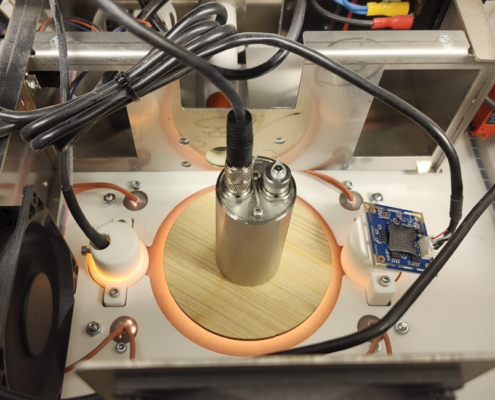
Overhead position (central): thermocamera mounted in place of the galvanometer, perpendicular to the print bed and geometrically centred over the build area. This position serves as the geometric reference for absolute thermal uniformity assessment.

Thermal camera setup in Snowwhite2 for temperature analysis

3. Results

3.1 Overhead Position — Print Bed Thermal Distribution

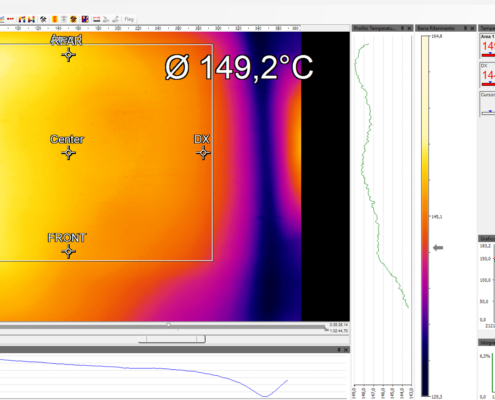
With the thermocamera in the overhead position, the thermal distribution across the print bed is substantially homogeneous in both distributor configurations:

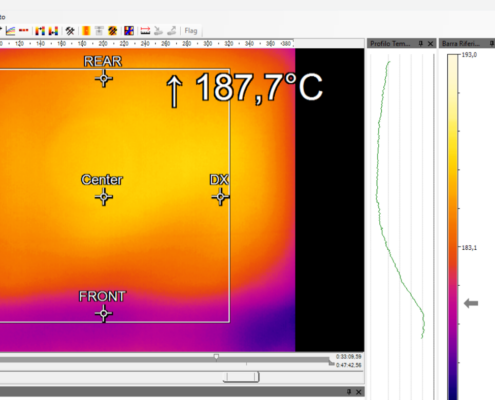
Standard distributor (100×100 mm): total spread of approximately 8°C across the five measurement points recorded on the surface. The front edge shows slightly lower values compared to the rest of the bed.

Snowwhite2 temperature distribution for standard distributor

Reduced distributor (20×40 mm): spread of approximately 5°C across the measurement points. The front edge again shows a slight decrease relative to the centre.

Snowwhite2 temperature distribution for standard distributor

3.2 Lateral Position — Comparative Observations

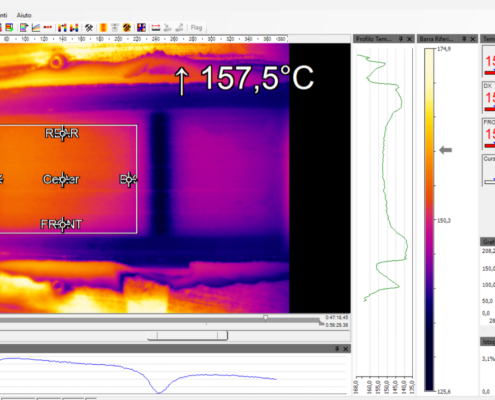
Acquisitions in the lateral position consistently reveal two phenomena relative to overhead readings, reproduced across both machines and both distributor configurations:

1. Absolute value offset: temperatures recorded in the lateral position are approximately 30–35°C lower than those acquired in the overhead position under identical operating conditions.

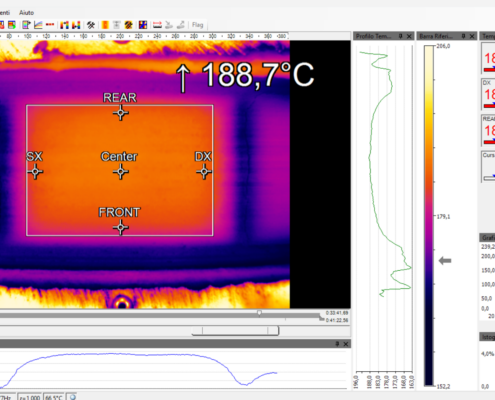
2. Left/right lateral gradient: in the lateral position, a systematic gradient appears between the left and right sides of the print bed, approximately 4°C with the reduced distributor and approximately 8°C with the standard distributor. The right side, opposite to the camera mounting side, consistently reads lower values. This gradient is absent in overhead acquisitions.

Snowwhite2 lateral temperature distribution for standard distributor

Standard distributor

Snowwhite2 lateral temperature distribution for reduced distributor

3.3 Agreement Between Onboard Sensor and External Thermocamera

A result of particular interest is the close agreement observed between the Snowwhite 2 onboard IR sensor readings and those of the external thermocamera in lateral position. The two instruments, though physically distinct and mounted on opposite sides of the galvanometer, consistently return concordant values, both approximately 30°C lower than overhead readings under the same conditions.

This agreement was observed consistently across all configurations and both machines tested.

4. Operational and Metrological Implications

The data collected allow the following practical guidelines to be formulated for researchers and laboratories using the Snowwhite2 or Snowwhite HT in applied or academic contexts:

Print bed homogeneity confirmed in overhead position. Overhead measurements show a maximum spread of 8°C across the full surface under the tested conditions. The print bed performs in accordance with the machine’s heating system specifications.

The lateral position introduces a systematic and reproducible offset. The 30–35°C offset between lateral and overhead readings is stable, consistent, and reproducible across different machines. This makes the lateral position unsuitable for absolute temperature measurement, but potentially valuable for relative monitoring of thermal drift, cycle-to-cycle variation, and session-to-session comparisons.

The machine’s process setpoints are calibrated to the onboard sensor geometry. The Snowwhite 2 operating parameters have been developed and optimised with reference to onboard sensor readings, which agree with lateral thermocamera acquisitions. The machine operates correctly with these readings. Researchers seeking to correlate process parameters with absolute powder surface temperatures should account for the systematic offset relative to overhead position readings.

The left/right gradient is absent in the overhead configuration. The systematic gradient observed in lateral position is not present in overhead acquisitions, which confirm the absence of significant non-uniformity in bed heating. The phenomenon manifests exclusively as a function of the acquisition geometry.

5. Conclusions

This study provides, for the first time in systematic published form, a quantitative thermographic characterisation of the print bed in Sharebot Snowwhite 2 SLS machines. The results demonstrate a homogeneous and reproducible heating system, and establish a clear metrological framework for interpreting onboard sensor readings in research and development contexts.

The methodological transparency of this work, including documentation of the technical challenges encountered during setup, in particular the requirement for bandpass filters specific to the CO₂ laser wavelength, is an integral part of its scientific value, and is intended as a practical reference for academic laboratories and research centres using Sharebot SLS technology.

The Snowwhite 2 and Snowwhite HT confirm their suitability as research-grade platforms for process investigation: the reproducibility of data across different machines, the modular architecture that enabled thermocamera integration, and the stable agreement of the onboard sensor with external measurements make them reliable instruments for studies requiring rigorous control and in-depth understanding of printing thermal conditions.