Exploring PVA in SLS: Technical Insights from Sharebot’s R&D
Exploring the boundaries of Selective Laser Sintering (SLS) requires rigorous testing of specialized materials, particularly when utilizing flexible, high-precision tools like the Sharebot SnowWhite2. Recently, our R&D team completed an internal evaluation of a thermoplastic PVA (Polyvinyl Alcohol) powder, a material prized for its unique properties yet demanding in its processing requirements. The SnowWhite2, equipped with a 14W CO2 laser and specifically designed for material research and development, provided the ideal environment to characterize how this hygroscopic polymer behaves under controlled industrial conditions.
Key Technical Findings
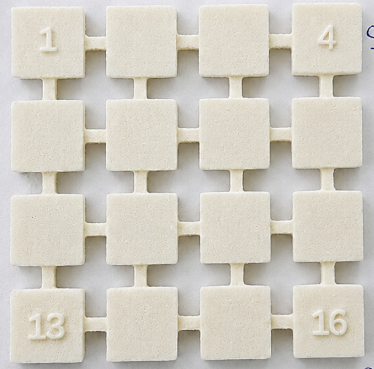
Our testing identified a stable processing window for PVA, highlighting the following essential parameters and operational insights:
-
Optimal Thermal Profile: Successful sintering was achieved at a powder bed temperature of 132 °C.
-
Laser Settings: An optimal balance was found using 35% laser power at a scan speed of 55,000 pps.
-
Atmosphere: All tests were conducted under an inert nitrogen (N₂) environment to ensure material integrity.
-
Material Handling: Due to its hygroscopic nature, pre-drying the powder for 2 hours at 40 °C is mandatory.
-
Process Observations: The powder exhibits limited flowability. While blade recoating was used for this study, we recommend exploring roller recoating or the integration of a flow agent to enhance surface planarity.
-
Maintenance: Rigorous post-process sieving is required to maintain powder quality for subsequent cycles.
Conclusion
The results demonstrate that the SnowWhite2 is highly effective for characterizing novel, challenging materials. While PVA demands specific handling protocols, our iterative testing has successfully mapped a pathway for reproducible performance, offering a solid foundation for further material development and end-use application optimization.