
• Link to Facebook
  • Link to X
  • Link to Youtube
  • Link to Instagram
  • Italiano Italiano Italian it
  • English English English en
Sharebot
  • Home
  • About us
    • Contact us
    • Our History
  • Printers
    • SnowWhite 2 SLS
    • SnowWhite 2 HT SLS
    • metalONE DMLS
    • Defiant 600x600x600
    • Odyssey 1,000×1,200×1,000
    • Enterprise 1,200×2,000×1,200
    • Galaxy DLP
    • Wax Jet MPJ
  • Post
  • Support center
    • Contact and info
    • Download
  • Resources
    • Case Histories
    • Brochures
    • Logos
    • Terms and conditions
  • Click to open the search input field Click to open the search input field Search
  • Menu Menu

Snowwhite2 paper: Innovating Steel – Filters & Refractories

26 June 2025

Welcome back to our exploration of cutting-edge research made possible, in part, by the precision of the Sharebot Snowwhite SLS 3D printing technology. Today, we’re featuring the scientific paper “Functionalized Feeders, Hollowware, Spider Bricks and Starter Casting Tubes for Increasing the Purity in Steel Casting Processes“. To begin, we’ll provide a straightforward explanation of what the study investigated and the main results it uncovered. Following this accessible overview, we’ll share the original abstract and relevant citations for a more in-depth look.
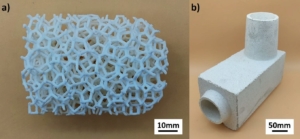
SLS printed foam template

 a) Template printed using Snowwhite –  b) Runner end piece for industrial casting

Understanding the study and its main result

This paper is about improving the purity of steel during a specific casting process called “ingot casting by bottom teeming.” This method is often used for high-quality, specialized steels.

The researchers found a promising way to make the steel cleaner: by using filters. They made special foam-like filters using a 3D printing technique called selective laser sintering (SLS), and they specifically used our Snowwhite printer for this. These printed foam structures were then turned into strong filters using other techniques.

They also looked at improving the containers and tubes (called “hollowware refractories”) that hold and guide the molten steel. They made these components “reactive” by adding special coatings, which helps remove existing impurities and stops new ones from forming.

The big idea is to use both the Sharebot Snowwhite-produced “active” filters and the “reactive” hollowware components together. This combination creates a powerful filtration system that uses the best parts of both methods to clean the steel.

They tested these new ideas in real industrial settings with a company called Deutsche Edelstahlwerke Specialty Steels Europe GmbH (DEW). After the tests, they examined the materials and steel samples to see how well the new methods worked compared to the old ones.

Main result

The key discovery here is the development of a combined filtration system that significantly improves the purity of specialty and alloy steels during ingot casting. By simultaneously using 3D-printed “active” filters and specially coated “reactive” refractory components, they found a more effective way to remove impurities from molten steel. This leads to higher quality steel products.

Functionalized Feeders, Hollowware, Spider Bricks and Starter Casting Tubes for Increasing the Purity in Steel Casting Processes

Tony Wetzig, Matthias Schwarz, Leandro Schöttler, Patrick Gehre & Christos G. Aneziris

Ref.: https://link.springer.com/chapter/10.1007/978-3-031-40930-1_32

Abstract

Although continuous casting became the state of the art for the casting of ordinary steel grades, ingot casting by bottom teeming still has relevance in the steelmaking industry, especially for the manufacturing of specialty and alloy steels. As for every casting process, the ever-increasing quality requirements by customers lead to increased demand for new technologies to increase the purity of the cast steel melt regarding its inclusion content. Due to the special design of the bottom-teeming ingot casting facility and the discontinuous operation as batch process, the application of filters is a promising approach. Tailored foam geometries were prepared based on additive manufacturing via selective laser sintering (SLS) and transformed into filters via modified replication techniques and flame spraying. Additionally to filter application, the functionalization and quality improvement of applied hollowware refractories has high potential to remove existing inclusions from the steel melt and avoid the formation of new inclusions during casting. The investigated hollowware components were manufactured by pressure slip casting on the basis of coarse-grained alumina compositions and subsequent functionalization by spray coating based on carbon-bonded alumina slurries. Simultaneous application of functionalized, “reactive” refractory components and flame-sprayed, “active” filters enables a combined filtration system which unites the advantages of the distinct filtration mechanisms. In the continuous casting of specialty steels, the conditions are more severe resulting in additional challenges regarding the application of filters. An approach investigated in this subproject is the use of extruded filter starter casting tubes above the tundish outlet. To achieve this, extrusion mixes based on cellulose derivatives and materials of the system Al2O3-ZrO2-C (AZC) were investigated for their suitability. The new concepts were tested in industrial casting trials in cooperation with the company Deutsche Edelstahlwerke Specialty Steels Europe GmbH (DEW). Post-mortem, the former melt-refractory interface of the applied components was investigated and steel samples from the ladle, the gating system and the ingot were analyzed in comparison to untreated samples.

/wp-content/uploads/2022/06/logoSharebot.jpg 0 0 site-admin /wp-content/uploads/2022/06/logoSharebot.jpg site-admin2025-06-26 14:52:062025-06-26 15:03:50Snowwhite2 paper: Innovating Steel – Filters & Refractories

Snowwhite2 paper: Monotonic and cyclic compressive performance of self-monitoring materials

16 June 2025

Our exploration of scientific advancements made possible by the Sharebot Snowwhite2 SLS 3D printer takes us to a fascinating study: “Monotonic and cyclic compressive performance of self-monitoring MWCNT/PA12 cellular composites manufactured by selective laser sintering“. In this piece, we’ll break down the core problem this research aimed to solve and the key discoveries they made. For those who want to dive deeper, we’ll also provide the original abstract and all referenced sources.

Understanding the study and its main result

This study looked at the mechanical and electrical properties of special 3D-printed structures when squished. These structures were shaped like honeycombs and made using our Sharebot Snowwhite2 3D printer. They used two different materials: pure PA12 (a type of plastic) and a mix of PA12 with carbon nanotubes (MWCNTs).

Here’s what they found:

  • Pure PA12 structures were stronger and could absorb more energy, especially the denser ones (30% and 40% solid material).
  • The MWCNT/PA12 structures were not as strong or stiff as the pure PA12 ones, but they were very good at absorbing energy (up to 53% efficiency).
  • Most interestingly, the MWCNT/PA12 structures could sense strain, meaning their electrical resistance changed when they were deformed. They were very good at this, acting like built-in sensors.
  • When these MWCNT/PA12 structures were repeatedly squished, their electrical resistance significantly increased as they got damaged. This means they could potentially detect damage as it happens.

Main result

The main discovery is that 3D-printed honeycomb structures made from a blend of PA12 and carbon nanotubes (MWCNTs) can act as self-sensing materials. They are not only good at absorbing energy but also have the remarkable ability to detect strain and damage as it occurs. This opens up possibilities for creating smart, lightweight structures that can sense their own condition, which could be useful in many applications like aerospace or automotive industries for real-time monitoring.

Monotonic and cyclic compressive performance of self-monitoring MWCNT/PA12 cellular composites manufactured by selective laser sintering

Muhammad Umar Azam (a), S Kumar (b), Andreas Schiffer (a) (c)
a) Department of Mechanical and Nuclear Engineering, Khalifa University of Science and Technology, Abu Dhabi, 127788, United Arab Emirates
b) James Watt School of Engineering, University of Glasgow, Glasgow, G12 8QQ, UK
c) Advanced Research and Innovation Center (ARIC), Khalifa University of Science and Technology, 127788, Abu Dhabi, United Arab Emirates

Ref.: https://www.sciencedirect.com/science/article/pii/S2666682025000106

Abstract

Herein, we experimentally investigate the mechanical and piezoresistive properties of selectively laser-sintered cellular composites under monotonic and cyclic compressive loading. Hexagonal honeycomb structures (HHSs) with relative densities of 20 %, 30 %, and 40 % were 3D printed from a ball-milled nanocomposite powder of multi-walled carbon nanotubes (MWCNTs) and polyamide 12 (PA12) with 0.3 wt.% MWCNTs. The pure PA12 HHSs exhibited lower porosity and superior mechanical properties, including collapse strength, elastic modulus and energy absorption, particularly at higher relative densities (30 % and 40 %). Notably, the specific energy absorption for the PA12 HHSs reached 24 J g⁻¹, under out-of-plane compression at 40 % relative density. Compared to neat PA12, the MWCNT/PA12 HHSs showed a reduction in strength and modulus but demonstrated excellent energy absorption efficiency of up to 53 %. Moreover, MWCNT/PA12 HHSs exhibited exceptional strain-sensing capabilities in the elastic region with gauge factors of up to 25. Cyclic tests showed that the zero-load resistance increased significantly as damage progressed during the collapse phase, highlighting their potential for application in smart, lightweight structures with integrated strain and damage-sensing functionalities.

/wp-content/uploads/2022/06/logoSharebot.jpg 0 0 site-admin /wp-content/uploads/2022/06/logoSharebot.jpg site-admin2025-06-16 15:54:382025-06-16 15:54:38Snowwhite2 paper: Monotonic and cyclic compressive performance of self-monitoring materials

Snowwhite2 paper: Separating critical elements from a NdFeB magnet

5 June 2025

Welcome back to our series showcasing the incredible influence of the Snowwhite SLS 3D printer on scientific progress! Our focus today is on a paper titled “Separating critical elements from a NdFeB magnet with aminophosphonic acid functionalised 3D printed filters and their detailed structural characterisation with X-ray tomography.”

To make sure everyone can understand this important work, we’ll first break down what the study aimed to achieve and what its key discoveries were, all in plain language. If you’re looking for the nitty-gritty details, the original abstract and supporting references will follow.

Understanding the study and its main result

This research looked at 3D-printed filters designed to separate valuable elements from old magnets. These filters are made mostly of a common plastic called nylon, with a special additive. Two different additives were tested: one that’s commercially available (Lewatit TP260) and another that was newly created (called aminobisphosphonic acid (1)).

First, they dissolved the old magnets using a mild acid. Then, they tested how well the filters could pick up different elements. The filters with the commercial additive (Lewatit TP260) were much better at grabbing rare earth elements (like Neodymium, found in magnets) compared to other metals. They were also more effective than the filters with the newly created additive.

Because of their strong performance, the PA-TP260 filters were chosen for the main separation process. Here’s how it worked:

  • Iron was removed first by causing it to settle out of the solution.
  • Then, the remaining elements were separated into four different groups using the filters: rare earth elements, boron and cobalt, copper, and aluminum.

A big discovery was that these filters are very durable and reusable. They could be used for 50 cycles of adsorbing and releasing elements without losing their effectiveness or changing their structure. This means they’re robust and can be used repeatedly.

Main result

The key discovery is that these 3D-printed filters, specifically those containing the Lewatit TP260 additive, can efficiently and sustainably separate critical elements from recycled magnets. This is significant because:

  • They use environmentally friendly chemicals (like methanesulfonic acid) for the separation process.
  • The filters are highly reusable and robust, making the process more cost-effective and sustainable in the long run.

Essentially, they’ve found a greener and more efficient way to recover valuable materials from electronic waste.

Separating critical elements from a NdFeB magnet with aminophosphonic acid functionalised 3D printed filters and their detailed structural characterisation with X-ray tomography

Emilia J. Virtanen, Janne Yliharju, Esa Kukkonen , Tia Christiansen, Minnea Tuomisto, Arttu Miettinen, Ari Väisänen, Jani O. Moilanen

Ref.: https://chemrxiv.org/engage/chemrxiv/article-details/677f6c57fa469535b94858e1

Abstract

3D printed filters containing 70 wt% of polyamide (PA) nylon-12 as a polymer matrix and either 30 wt% of a commercial aminophosphonic acid functionalised resin (Lewatit TP260) or a synthetized aminobisphosphonic acid (1) as an additive were investigated for the separation of elements from a NdFeB magnet waste. Before separation studies, the magnet was leached with 10 v/v% methanesulfonic acid using S/L ratio of 5 g/l for 20 h at 60 °C. The PA-TP260 filters adsorbed rare earth elements (REE) more efficiently than transition and main group elements and showed greater uptake than the PA-1 filters at the studied pH range of 0.15–4.00. Thus, the PA-TP260 filters were selected for the separation process, wherein Fe was selectively precipitated from the leachate, while solid-phase extraction was used to separate the remaining elements from the leachate to four distinct fractions: REEs; B, Co; Cu; and Al. Neither significant decrease in the adsorption and desorption percentages of the PA-TP260 filters over 50 adsorption-desorption cycles, nor structural changes, as confirmed by the detailed X-ray tomography studies, were observed. The results indicate that the PA-TP260 filters are robust and fully reusable. Overall, the results demonstrated that the highly porous 3D printed filters efficiently separate critical elements from the NdFeB magnet leachate only by using ecofriendly MSA, ammonium chloride, and potassium oxalate solutions paving the way towards greener separation processess for the critical elements.

/wp-content/uploads/2022/06/logoSharebot.jpg 0 0 site-admin /wp-content/uploads/2022/06/logoSharebot.jpg site-admin2025-06-05 15:12:292025-06-05 15:12:29Snowwhite2 paper: Separating critical elements from a NdFeB magnet

Pages

  • big
  • Call2022
  • Case Histories
  • Contact us
  • defiant
  • Download
  • enterprise
  • galaxy
  • H2politO
  • Home
  • Home2
  • Home3
  • Novaresin
  • odyssey
  • Our History
  • Post
  • Printers
  • Privacy and cookie policy
  • Resources
  • Sharebot metalONE Club
  • Sharebot SnowWhite Club
  • Support center
  • Terms and conditions
  • wax510
  • Aprilia Racing
  • Brochures
  • Logos
  • VIPER
  • Colnago
  • 43 Pro
  • Eye’m
  • 3D Printed human organs
  • Vismaravetro
  • Plus
  • Sharebot XXL Plus
  • ULTRA
  • Fiberbow
  • C4 HS
  • Sharebot Q
  • SnowWhite 2
  • metalONE
  • Sharebot Q XXL

Categories

  • metalone
  • snowwhite

Archive

  • June 2026
  • March 2026
  • February 2026
  • January 2026
  • November 2025
  • October 2025
  • September 2025
  • July 2025
  • June 2025
  • May 2025
  • April 2025
  • March 2025
  • February 2025
Sharebot S.r.l. - VAT: IT03482570136 - REA: (LC) 318035 - Privacy e cookie policy
Scroll to top Scroll to top Scroll to top

This site uses cookies for the best navigation experience. You can click on "settings" to get more information about cookies and to select which one to allow.

Accept selectedSettings

Cookie and Privacy Settings


How we use cookies

We may request cookies to be set on your device. We use cookies to let us know when you visit our websites, how you interact with us, to enrich your user experience, and to customize your relationship with our website.

Click on the different category headings to find out more. You can also change some of your preferences. Note that blocking some types of cookies may impact your experience on our websites and the services we are able to offer.

Essential Website Cookies

These cookies are strictly necessary to provide you with services available through our website and to use some of its features.

Because these cookies are strictly necessary to deliver the website, refusing them will have impact how our site functions. You always can block or delete cookies by changing your browser settings and force blocking all cookies on this website. But this will always prompt you to accept/refuse cookies when revisiting our site.

We fully respect if you want to refuse cookies but to avoid asking you again and again kindly allow us to store a cookie for that. You are free to opt out any time or opt in for other cookies to get a better experience. If you refuse cookies we will remove all set cookies in our domain.

We provide you with a list of stored cookies on your computer in our domain so you can check what we stored. Due to security reasons we are not able to show or modify cookies from other domains. You can check these in your browser security settings.

Google Analytics Cookies

These cookies collect information that is used either in aggregate form to help us understand how our website is being used or how effective our marketing campaigns are, or to help us customize our website and application for you in order to enhance your experience.

If you do not want that we track your visit to our site you can disable tracking in your browser here:

Other external services

We also use different external services like Google Webfonts, Google Maps, and external Video providers. Since these providers may collect personal data like your IP address we allow you to block them here. Please be aware that this might heavily reduce the functionality and appearance of our site. Changes will take effect once you reload the page.

Google Webfont Settings:

Google Map Settings:

Google reCaptcha Settings:

Vimeo and Youtube video embeds:

Other cookies

The following cookies are also needed - You can choose if you want to allow them:

Privacy Policy

You can read about our cookies and privacy settings in detail on our Privacy Policy Page.

Privacy e cookie policy
Accept allAccept selectedRefuse all
Open Message Bar Open Message Bar Open Message Bar