
Developing an Edible, Water-Soluble SLS Powder
Printing Candy With a Laser, Twelve Years Later
The idea
This is not the first time a SnowWhite has been pointed at sugar.
Back in September 2014, when the original SnowWhite was being introduced as the first low-cost SLS machine on the market, the R&D team ran what the press at the time called a rather mad experiment: sintering ordinary kitchen sugar, producing a set of caramelised sculptures. It drew attention well beyond the usual additive manufacturing audience, and left an open question behind: a fun experiment, or the start of something.
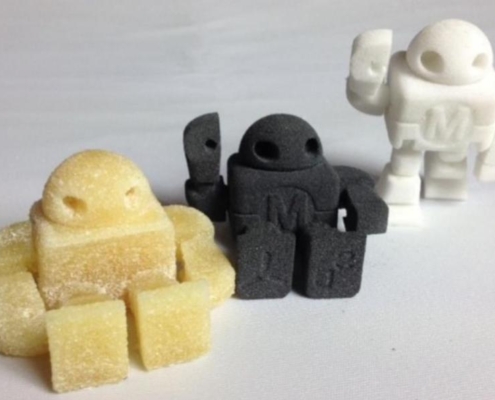
It stayed an experiment. Twelve years later, this is an attempt to take the same idea seriously: not a sugar sculpture, but a formulated, reproducible, food-grade powder with a defined process window.
Selective laser sintering was built for engineering polymers. But the physics underneath it — a low-melting fraction that binds a structural fraction, activated point by point by a laser — is not specifically polymeric. It only asks for a well-ordered hierarchy of temperatures.
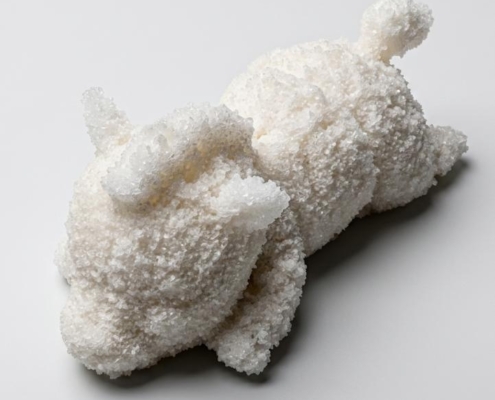
Sugars and polyols have that hierarchy naturally. They also happen to be edible and water-soluble, which opens a category of objects that additive manufacturing rarely touches: free-form shapes meant to be dissolved rather than kept. Flavoured pieces designed to disappear into a cocktail or a soup, carrying geometries no mould could produce.
The longer-term aim of this project is more ambitious. Some sugars change colour above a threshold temperature, which means the same laser that builds the object could also decorate it modulating energy to caramelise selected regions and draw a pattern directly during the build, with no ink, no second tool and no post-processing.
The principle itself is proven: it already works in a polymer powder, where sucrose browns selectively under a modulated beam and holds the contrast. Reproducing it in an edible formulation has not been achieved yet, the sugar-and-polyol system leaves a much narrower margin between the energy that sinters and the energy that colours, and closing that gap remains the focus of ongoing work.
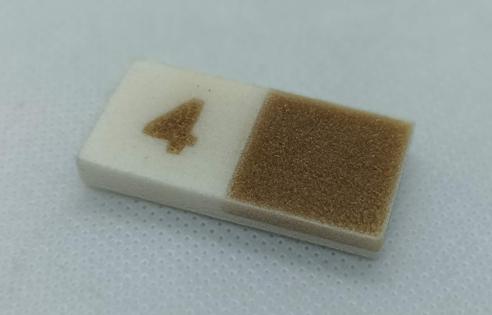
What follows covers the part that does work: a printable, food-grade, water-soluble powder, and the formulation route that got its flow behaviour and feature definition to a usable level.
Why an open-parameter machine matters
A campaign like this is impossible on a closed system. Every formulation change shifts the process window, and the window has to be found again from scratch each time. What is needed is not a better recipe engine but direct access to the machine.
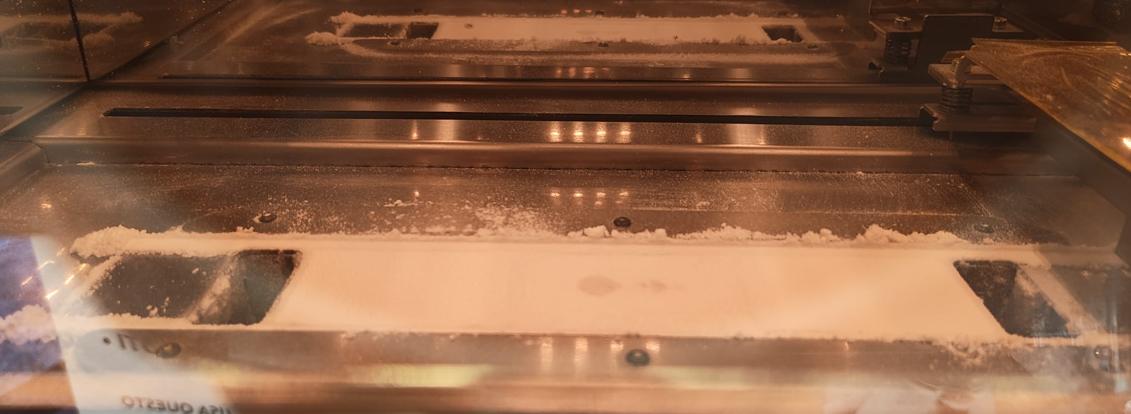
On the SnowWhite2, process parameters are fully open and adjustable from the machine’s own interface, and the build volume is kept under an inert nitrogen atmosphere throughout the cycle.
Three further properties shaped the campaign.
A reduced-volume dispenser. This is the one that mattered most, and it is easy to underestimate. The machine’s dosing system allowed each cycle to run on roughly 70 g of powder. In a formulation campaign that number sets the pace of everything: every batch is hand-mixed, every ingredient is weighed, and most attempts are expected to fail. On a machine requiring kilograms per fill, testing a variant means committing an entire batch of material to a hypothesis — which in practice means testing fewer hypotheses. At this scale, a new formulation can be mixed in the morning and evaluated the same day, and a failed one costs almost nothing. Two iterations of the recipe happened in a short span for this reason alone.
Formulation
Version 1 — the three-component base:
The starting point follows a simple ordering: a binder that melts low, a structural filler that does not melt at process temperature, and a colour precursor reserved for the intended next phase of the project.
Ingredients:
Maltodextrin DE 10–15 Structural scaffold ~45% does not melt; softens above Tg (~140–160 °C when dry)
Erythritol Binder ~40% sharp melting point, ~121 °C
Micronised sucrose Colour precursor ~12% caramelises ~165–185 °C
One clarification proved central here. Maltodextrin is the obvious candidate for the binder role and it is the wrong one: it is amorphous, has no sharp melting point, and its glass transition collapses in the presence of moisture. Its correct role is the scaffold, the functional equivalent of a high-melting filler, while erythritol, with its well-defined melting point, forms the sintering necks.
This version printed, but it failed on two counts. Powder flow was marginal, recoating left streaks, and feature definition suffered accordingly. And no colour shift occurred: the powder remained white even at high energy density.
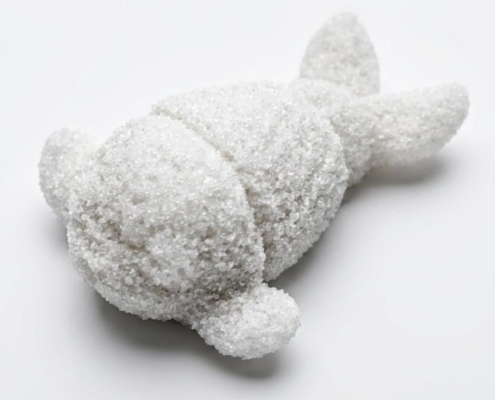
Version 2 — flow agents:
The second version changed the flow strategy entirely and adopted agents native to food processing. A small fraction of glucose was added at the same time, as a lower-threshold colour precursor intended to make browning easier to trigger.
Ingredient:
Maltodextrin DE 10–15 Scaffold ~40%
Erythritol Binder ~40%
Micronised sucrose Colour precursor ~11%
Rice starch Primary flow agent ~4%
Calcium carbonate (E170) Anti-caking ~2%
Fine glucose Colour precursor, low threshold ~3%
The result was the clearest improvement of the campaign: markedly better powder flow and a substantial gain in printed feature definition. Rice starch proved to be an effective flow agent and a natural fit for the context.
The colour behaviour, however, overshot. Browning now occurred even at the energy level used simply to sinter the powder, and by the end of the build every region, regardless of the energy it had received, had settled at the same light brown. The window between sintering and colour change had closed rather than opened.
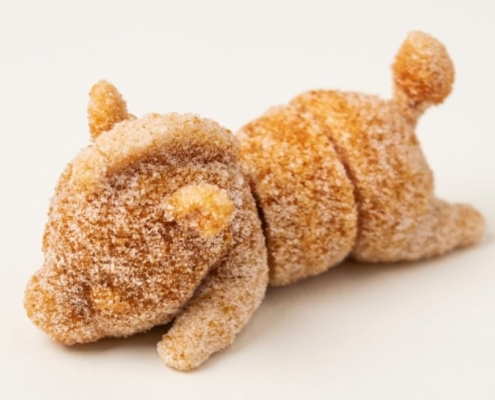
Process parameters
Parameters:
Bed temperature 80-90 °C below the erythritol melting point (121 °C);
Layer thickness 0.10–0.14 mm;
Hatch spacing 0.10–0.14 mm;
Sintering Rate 45000 / Power 25%;
Atmosphere Nitrogen;
Where this stands
The powder prints, dissolves, and holds detail well enough to be useful. Flow behaviour, which was the limiting factor early on, is no longer the constraint.
The decorative objective, patterning parts through selective caramelisation during the build, remains open. Browning turns out to be governed by time at temperature rather than peak temperature, which makes it a fundamentally different problem from sintering, and one that interacts with the thermal history of the whole build rather than with the laser alone. That work is ongoing.
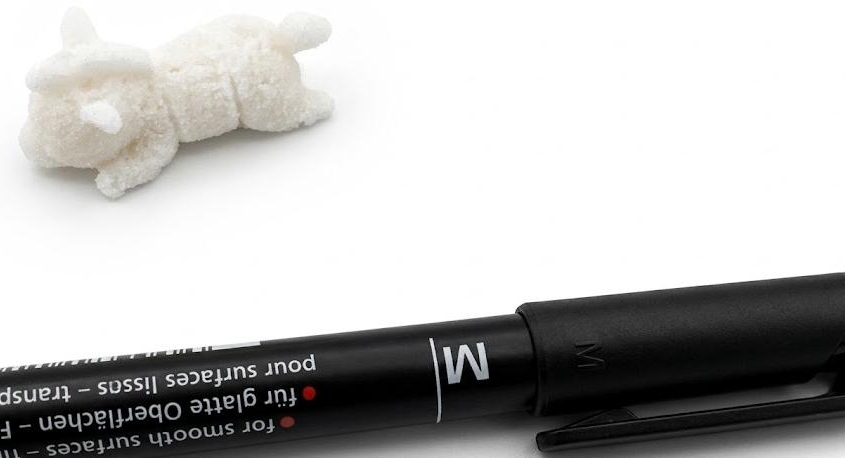
A third batch is currently in mixing and testing. It goes in the opposite direction from the second: the glucose is removed and the calcium carbonate reduced to a trace, since together they lowered the browning threshold below the energy needed simply to sinter, closing the process window rather than widening it. The binder fraction is raised in exchange, on the principle that parts which crumble at low energy call for more binder rather than more heat; raising the energy to obtain cohesion only pushes the whole window upward.
Values reported here refer to the trials described and should be treated as a starting point.